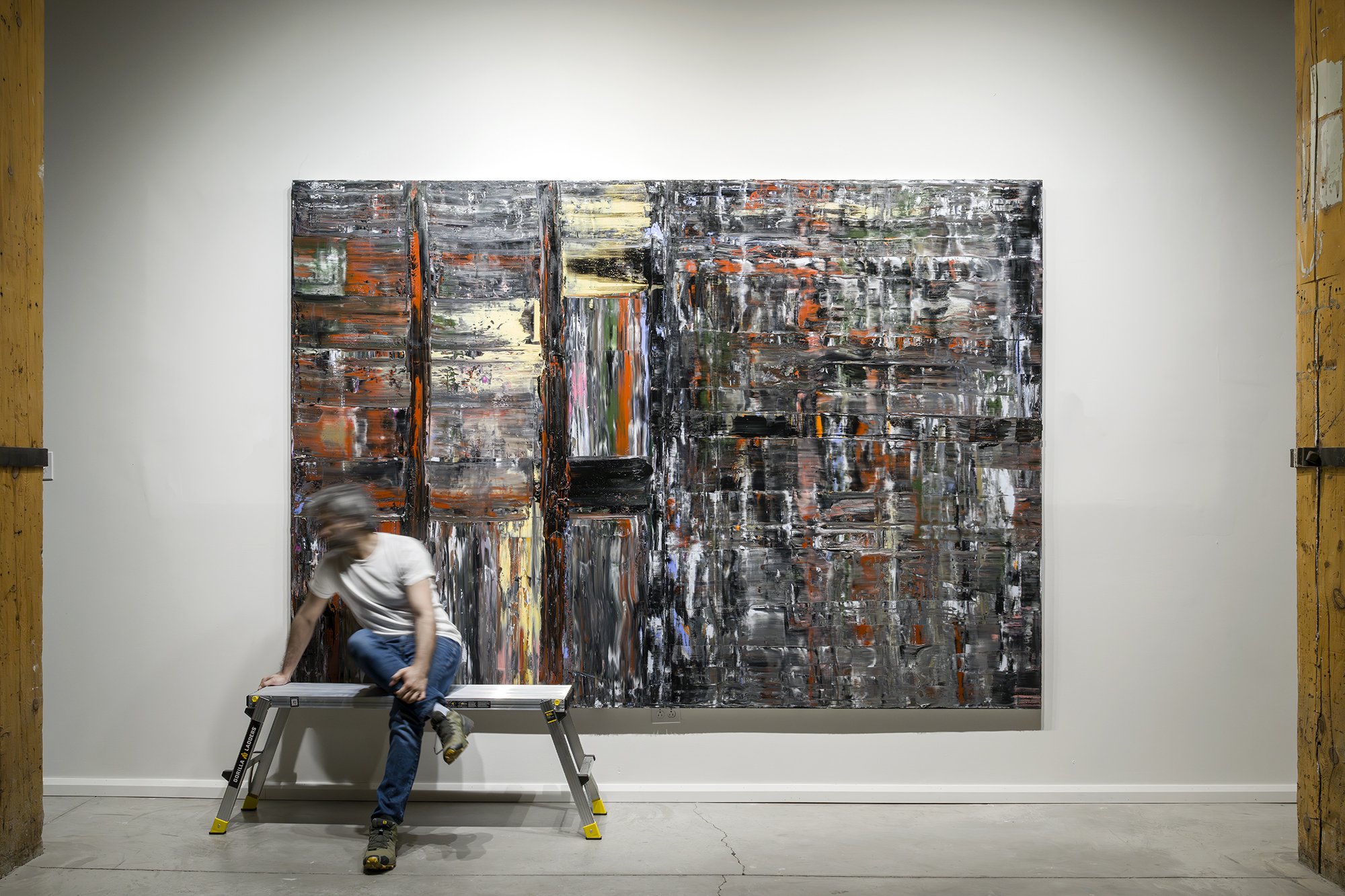
‘‘Painting came to me as a salvation at a time that I knew I didn’t want to pursue acting anymore. There was this very strong desire in me that wanted to be private perhaps I should say emotionally private and acting was like getting naked on stage in front of people. I could not separate myself from it, painting gave me that opportunity to be separate from the canvas. In acting you are both the artist and canvas and I wanted to be emotionally separate and alone.”
Yet still in his work a lot of the New York acting days influences are evident . From the gestural movements which were informed by Michael Chekhov’s psychological gesture concept to his figurative paintings which are directly influenced by Balinese masks.
A’yin Morradi was born and raised in Iran and according to him he was “a grown up man’’ when he moved to New York to study acting and drama at Lee Strasberg and later Micheal Chekhov Studio which he credits as one the most influential concepts that has formed him as an artist and by large a human being.
“ Balinese masks are not just something you wear to attend a ceremony! They are healing masks that help you to reveal or embody what’s inside of you,so these are revealing and not hiding masks. In acting the actor creates a revealing mask to portray the character. In my paintings sometimes these faces show up and it’s very hard for me to ignore or destroy them and that’s when you realize that the painting has the life of its own and is the one that’s now leading you. I have no idea where they come from and I don’t wanna know’’
Psychological Atmospheres is another phrase he uses to describe his paintings:
“These are the thought and emotional processes that might be going on inside the mind. Colors define the emotions or sense memories and squares define the thoughts or rational thinking part of the mind. By doing the squares I like to show that I'm conscious.’’
‘‘These paintings are all about inner thoughts triggered by emotional charges which at the end create psychological atmospheres. A canvas is like a crime scene in which you look for the unraveling story of human emotions through gestures and colors.’’